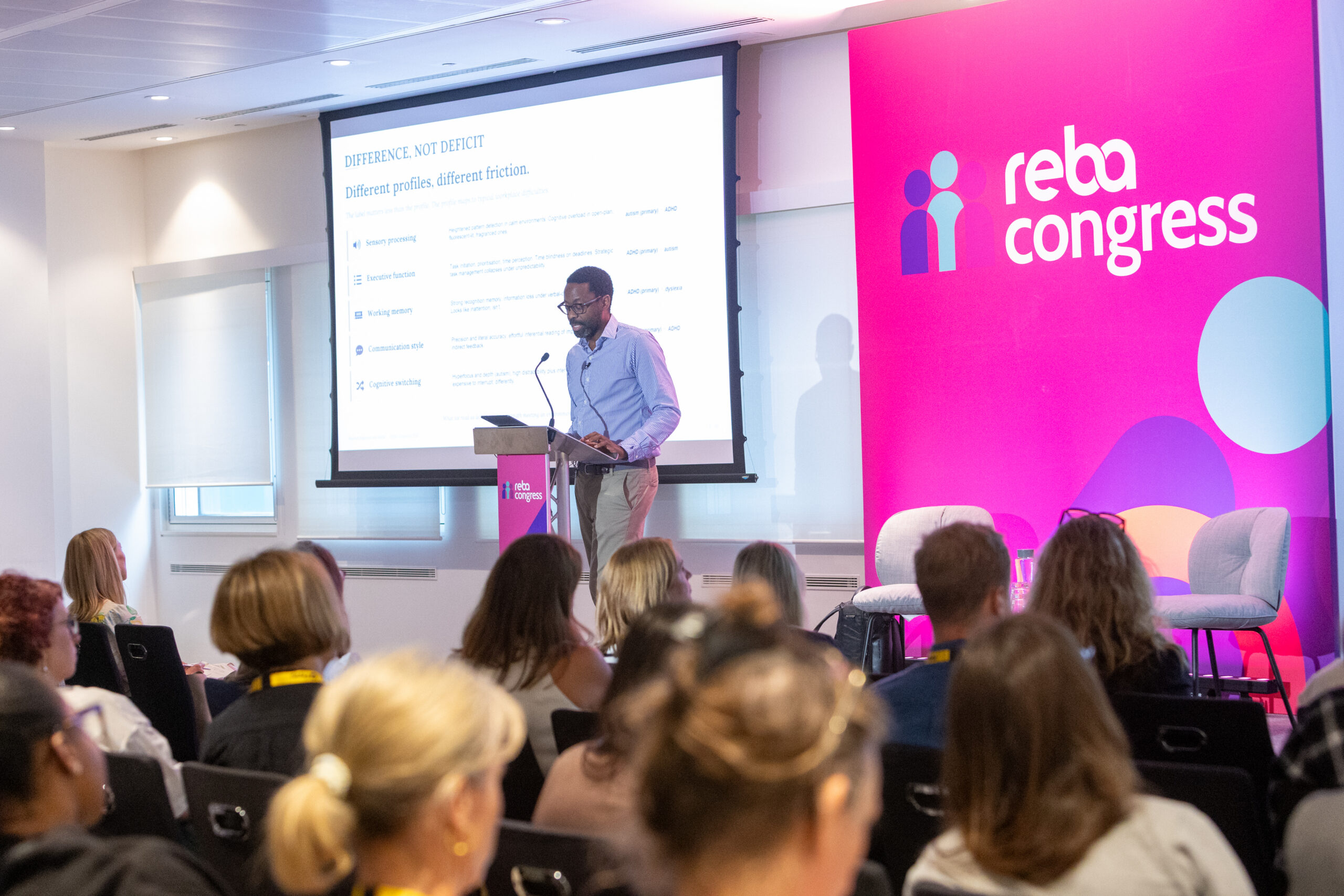
Dr. David Mushati, Chief Clinical Officer at Melios, spoke at REBA Congress 2026 on what unrecognised neurodivergent needs are really costing organisations, and what it looks like to design workplaces that actually work.
Beth was a marketing executive at a UK consultancy who had been there for five years, earned three promotions, and consistently exceeded her targets.
Her final appraisal described her as exceptional: someone who delivered consistently and didn’t make waves.
She resigned the next morning, with no other role lined up.
In her exit interview she said: “I spent fourteen hours a day pretending to be someone else. I couldn’t do it any more.”
An autism diagnosis followed three years later. She has not returned to corporate work.
The organisation read Beth’s performance as proof she was fine.
But underneath that performance was a person spending enormous energy trying to appear acceptable, easy, polished and low maintenance. Her later diagnosis explains the mechanism: masking, camouflaging, sensory and social strain, exhaustion, delayed self-understanding.
Beth did cope. Too well. For too long. At too high a cost.
The 2024 Buckland Review found that only around three in ten working-age autistic people were in employment, despite many wanting to work. The gap is not about capability. It is about environments that were never designed with them in mind.
Dr. David Mushati opened his REBA Congress 2026 session with Beth’s story. As Chief Clinical Officer at Melios, his argument was direct: the biggest cost of neurodiversity in the workplace is not the employees organisations know about. It is the ones they don’t.
What neurodiversity in the workplace actually means
Neurodiversity, the natural variation in how human brains process information, communicate and experience the world, affects an estimated 15 to 20% of adults.
It is not a condition. It is a fact of population biology.
Within that population, autism and ADHD are the two most common adult presentations. Around 70% of autistic adults remain undiagnosed. ADHD affects an estimated 3 to 5% of working-age adults, the majority also undiagnosed or identified late in life.
What that means for organisations is this: the number of employees quietly masking or compensating at work, diagnosed or not, is far higher than any disclosure data will tell you.
The hidden cost of masking at work
Masking is the cognitive effort of suppressing one’s natural style to fit an environment.
For many neurodivergent employees, that means rehearsing scripts before meetings, managing sensory overload in open-plan offices, hiding difficulties with task initiation, and simulating the kind of sustained focus that the environment demands.
That energy comes from somewhere. Research consistently links high levels of masking and compensation to anxiety, depression and burnout.
And it is entirely invisible until it is not.
“Organisations are often unknowingly rewarding performative social conformity over sustainable performance.”
Dr. David Mushati, Chief Clinical Officer, Melios
When masking eventually becomes visible, it tends to look like performance issues, increased absence, or an unexplained resignation. By then, the organisation is already in reactive mode.
This is a workplace design problem, not a neurodiversity problem
Many workplaces are cognitively exhausting for a lot of people.
Autistic and ADHD employees simply experience the friction earlier, and more intensely.
David identified four inherited design features that drive that friction. None were ever validated. All of them cost neurodivergent employees disproportionately.
- Open-plan offices and constant interruption. Research estimates a 23-minute recovery cost after each interruption. In distractor-rich environments, sustained output becomes structurally difficult for many people.
- Implicit communication norms. Indirect feedback, unstated rules and verbal-only briefs are treated as basic professional competence, rather than recognised as real cognitive demands.
- Unpredictability as the norm. Late changes and shifting priorities create acute cognitive load. For many neurodivergent employees, recovery is slow.
- Presence rewarded over output. Hours at a desk and meeting attendance proxy contribution. This model penalises employees whose output is high but whose presentation does not match the visible norm.
These features were inherited. They were not designed with cognitive diversity in mind, because at the time, cognitive diversity was not part of the conversation.
Why waiting for disclosure is already too late
Most autistic and ADHD adults disclose only after problems have already emerged.
Many fear stigma more than workload. Proactive disclosure is rare. Retrospective disclosure, after a crisis, is common.
As David put it at REBA: if disclosure is your detection system, your organisation is already operating reactively.
By the time someone raises a hand, you may have already lost months, or even years, of their sustainable performance.
There is also a communication dimension that HR professionals rarely account for. Research on what is known as the double empathy problem shows that the communication breakdown between autistic and non-autistic people is bidirectional. Negative judgements about autistic employees often form within seconds, based on communication style rather than content. When the same material is presented as text only, autistic speakers are rated more favourably.
Locating social difficulty inside one person costs you that person.
What unrecognised cognitive load is actually costing your organisation
David was deliberate in framing this as a performance issue, not just a wellbeing one.
When neurodivergent needs go unrecognised, organisations typically see:
- Retention risk. High performers exit before formal disclosure or a capability process begins.
- Burnout. Cumulative cognitive load presents as depression and is frequently misdiagnosed.
- Presenteeism. Visible attendance, invisible output. Sustained effort without sustainable results.
- Reduced psychological safety. When performative conformity is rewarded, candour suffers across the wider team, not just for neurodivergent employees.
There is also a less discussed cost: the potential being overlooked. Research indicates that autistic employees show reduced susceptibility to the bystander effect and lower moral disengagement. They can be a stabilising counterweight in organisations that rely on people speaking up, though that value rarely appears in a business case because it is rarely measured.
Want to take the practical next steps back to your team?
Download the five shifts
Dr. David Mushati outlined five concrete changes any organisation can make, with a clear what-to-do action for each one. No jargon. No generic advice. Just a framework you can act on.
Enter your details below to download.