This blog draws on our first Melios Insights webinar, Navigating Summer Together: Helping Anxious Children Through Transitions, hosted by Rebecca Kinnear, Clinical Lead for Treatment Services at Melios.
For children who rely on routine to feel settled, summer can be genuinely harder than term time. If that sounds familiar, you’re not alone, and there’s a lot you can do to help.
What causes anxiety in children?
Anxiety in children is a threat detection system doing its job, it isn’t broken, it’s simply overtuned. It treats non-dangerous things, a new activity, a social situation, being away from a parent, as if they were genuinely dangerous.
A child’s brain is still learning how to tell safe from unsafe, and it’s wired to look for safety through familiarity. In known environments, a child’s nervous system feels regulated because it can predict what happens next. In new or unfamiliar places, that predictability disappears, and childhood anxiety often follows.
What is anxiety? The anxiety equation
Anxiety isn’t just about how dangerous something actually is, it’s about the gap between how dangerous it feels and how capable a child feels of handling it:
Anxiety = Perceived danger ÷ Perceived ability to cope
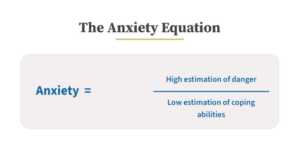
That’s why the same situation, a new class, a loud room, a change of plan, can barely register for one child and feel overwhelming for another. It also means there are two ways to help: reduce how dangerous something feels, and/or build a child’s sense that they can cope with it. Most of what follows does one or the other.
Why do children get anxious during the summer holidays?
Term time comes with structure: the same routines, the same faces, the same rhythm to the day. Summer holidays strip a lot of that away, and for a child who relies on predictability to feel calm, that loss of routine can be a genuine trigger for anxiety.
A few other things pile on at the same time: the pressure of a “perfect summer” from social media, body image worries that come with warmer weather, a busier social calendar, and the loss of school-based support. For some children, a change of location, different bed, different food, different sounds, adds another layer of overwhelm.
Signs of anxiety in children
This is one of the easiest things to miss. In children, anxiety symptoms very often show up as:
- Anger or irritability. This is a common sign of anxiety in children, and often mistaken for bad behaviour rather than fear.
- Tiredness, restlessness or the opposite, appearing constantly “on the go”.
- Physical symptoms with no clear cause. Stomach aches and headaches, especially before school or transitions, are often how younger children express anxiety when they don’t yet have the words for it.
- Withdrawal. Going quiet, isolating, spending more time alone, particularly in anxious teens.
- Reassurance-seeking. Asking the same question repeatedly, or excessive “what if” thinking.
None of these confirm anxiety on their own, but a pattern of them is worth paying attention to.
A practical toolkit for the summer
Help your child feel a sense of control. Offer choices where you can, what to have for lunch, which activity to do first. A sense of agency is protective against childhood anxiety.
Make the unfamiliar feel familiar. If you’re going somewhere new, show your child photos or videos of the place beforehand and talk through the journey step by step. Even small details help an anxious child’s brain feel more settled.
Build in a loose, predictable structure. Children don’t need a rigid timetable, but knowing roughly what’s happening each day reduces a lot of the anxiety that comes from not knowing what’s next. Familiar routines, a bedtime story, a favourite snack at a similar time each day, act as emotional grounding points.
Keep some outdoor time and movement. Getting outside, and a bit of exercise, genuinely helps with mood.
Balance screen time with real-world connection. Staying in touch with friends online matters, but it works best alongside in-person interaction too.
Watch for avoidance, and understand why it backfires. Avoidance gives immediate relief, which is exactly why it’s so hard to resist, but it teaches the brain the wrong lesson: that thing really was dangerous. This is called accommodation, and it’s one of the best evidenced factors that keeps childhood anxiety going. It’s also completely understandable, it comes from love.
Name it to tame it. A simple feelings vocabulary, “I can see your worry monster is big today”, externalises the anxiety as separate from the child, which reduces shame and gives you both a shared language.
Try a worry scale. Ask your child to rate a feeling from nought to ten. It creates a bit of psychological distance (“it’s a six, not a ten”) and gives you a shared way to talk about next steps.
Set aside worry time. A dedicated ten minutes a day to bring worries to you, rather than anxiety intruding all day, contains it rather than suppressing it.
Build a ladder to success
The alternative to avoidance isn’t “throw them in the deep end,” it’s graded, supported exposure, helping your child approach the feared thing in small, manageable steps, with you alongside them, so their brain gets new evidence: they did the scary thing, and they coped.
Pick one thing your child is avoiding, then break it into small steps. For a new summer club, that might look like attending for ten minutes with you present, then ten minutes alone, then the full session. Get your child involved in building the ladder themselves, ownership matters.
Move to the next step only when your child feels ready, not on a fixed timeline.
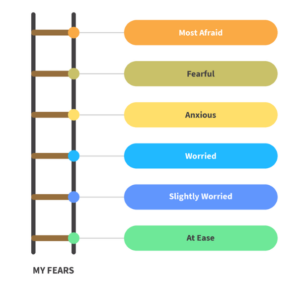
Want this as something you can keep? Download our Summer Anxiety Toolkit for Parents, a printable version of the ladder to success, the worry scale and a worry time tracker, ready to use with your child.
How to calm an anxious child in the moment
When anxiety hits, the sequence matters. First, validate: name the feeling briefly, without over-explaining. Then regulate: help the body calm down before attempting to problem-solve. You cannot reason with a dysregulated nervous system.
As Rebecca put it in the webinar:
“If you take away one thing: your calm, confident presence is more powerful than any technique on this list. You don’t need to fix the anxiety or make it disappear this summer, you need to help your child practise coping with it, one small step at a time, with you alongside them. You don’t have to be the bodyguard, be the coach and cheerleader.”
And for parents of teenagers specifically:
“If you have to choose between winning an argument and staying emotionally close, choose closeness. The relationship is the vehicle for influence, especially in adolescence.”
Want the full session? Watch the recording of Navigating Summer Together here.
When should I seek help for my child’s anxiety?
Some summer holiday anxiety is developmentally normal, and responds well to the approaches above. It’s worth seeking professional input if you’re noticing:
- Anxiety that’s significantly limiting daily functioning, eating, sleeping or leaving the house.
- Physical symptoms with no medical cause, frequent stomach aches or headaches.
- Anxiety that isn’t easing with reassurance and support over several weeks.
- Any signs of self-harm or your child expressing they don’t want to be here.
Your GP is a good first point of contact, and school pastoral staff can also refer into local services once term resumes.
Get support for your child’s anxiety
If you’re wondering whether what you’re seeing is more than a summer wobble, we’re happy to talk it through, no commitment required. Melios offers private mental health, ADHD and autism support for children, young people and adults, as well as single session parent consultations.